We hope you love the products we recommend! Just so you know, BuzzFeed may collect a share of sales or other compensation from the links on this page. Oh, and FYI — prices are accurate and items in stock as of time of publication.
Since the way workout gear fits is very different for different bodies — like boob support! — we knew both of us had to collectively agree on the best brand. I wear a size small and my mom wears a large; I wear a 32A bra and my mom wears a 36D.
We decided to test out a top, leggings, and high/medium/low support bras from each brand. Our "test" for each included: jumping jacks, squats, weight reps, and a five-minute jog/run. (We did these tests on different days, the photos below are just so you can get a good idea of what the clothes look like!)
I had my mom do this article with me because she loves BuzzFeed and "wanted to represent the people over 50 who wear athletic clothes, too," lol. SHE TURNS 60 IN APRIL!!! Oh, and she didn't want her name in the article, so she is just "mom."
A lot of these workout lines have styles that we did not test. We reviewed the clothes based off the styles we tried and how they fit our bodies. Every body is different, though, so what worked for us may not be the best option for you!
Under Armour and Calia sent BuzzFeed free samples, but we were under no obligation to positively review them in this article. All opinions are our own.
You’ll want to be completely topless for this to ensure you’re measuring your breasts at their most natural, Harrington says — no padding, binding, lifting, or constricting. Take the measuring tape and wrap it around your ribcage, just under your bust. The measuring tape should be parallel to the ground.
You should be able to fit a finger under the measuring tape. “If you’re pulling your tape measure too tightly, you might wind up getting a bra band that’s too tight,” Harrington says. “If you have a larger or heavier bust, you probably do want a bra band that’s a little bit tight, but let’s start off with accurate measurements first. If you have a smaller bust, having a bra band that’s too tight can be very uncomfortable, especially if you are thinner and have less cushion on your rib cage because the bra band is resting directly on those bones.”
Round the measurement to the nearest whole number and you’ve got your band size. Depending on the manufacturer, you may need to add four if the measurement is even and add five if the number is odd. So if you measured 34 inches, your band size would be 38; if you measured 27 inches, your band size would be 32. Historically, this has been standard practice in bra measuring and manufacturing — and no one is really sure why. Some speculate the “plus-four rule” was to accommodate for breathing room when bras were made out of un-stretchy material like silk and satin. Popular bra-fit community r/ABraThatFits traced the plus-four method back to the 1960s when bra measurement practices changed. Again, it’s important to consult each manufacturer's fit guide to determine if you’ll need to do this addition.
Frazer Harrison / Getty Images / BuzzFeed / Farrah Penn
Hi all, my name is Farrah and I'm pretty interested in skincare, especially when it comes to celebrities. Of course, some celebs have access to expensive products or certain skincare doctors (see: fillers, Botox, peels, lifts, etc.), but others are pretty forthcoming about their routines: like Chrissy Teigen!
Frazer Harrison / Getty Images
Not only does Chrissy Teigen have *chef's kiss* perfect skin, but she's talked about certain things she's does to keep it lookin' clear and glowy. Personally, I appreciate her transparency when it comes to breakouts. EVEN CELEBS HAVE TO DEAL WITH PIMPLES.
After doing a little bit of research, I found some things Chrissy uses in her skincare routine:
So, for 30 days, I decided to discard my typical routine in favor of trying out Chrissy Teigen's skincare regimen!
When it came to face wash and lotion, Chrissy says she's not a stickler for a certain product. This meant I had a little more leniency in the routine. So, since Chrissy Teigen's makeup artist uses Tatcha's oil to prep her face, I decided to try Tatcha's starter kit for normal/oily skin. I figured I would use the cleanser that came in this kit with the Foreo device, since you're supposed to use it in place of a washcloth.
When I first opened the Foreo Luna 3, I literally thought it was the most EXTRA skincare tool I'd ever seen. First, you had to download an app to get it to turn on. That annoyed me because not everything in life should require a freakin' app. Also, it took me a week before I realized that you could operate the Luna 3 without having to access the app with wet-ass hands — but that was my fault for not reading the directions very well. It was a big change from washing my face with a washcloth.
Farrah Penn / BuzzFeed
The Foreo Luna 3 can be purchased for $200 from Foreo.
The Tatcha Rice Polish was a good exfoliant, so I limited myself to using this twice a week. It pours out like sand, but then you add water and it froths right up. This was more enjoyable to use with the Foreo device (more on that in a sec) because I felt like I was getting a deep clean.
Farrah Penn / BuzzFeed
Tatcha's Rice Polish can be purchased for $65 from Tatcha.
As an everyday face wash, Chrissy has said she's used iS Clinical Cleansing Complex in the past. This felt really slippery (but gentle) when I washed my face twice a day, and it didn't cause any aggressive stripping of my skin.
I ended my nightly skincare cleanse by applying Tatcha's moisturizer on my skin. I quickly realized I hated using this during the day because it made me look SO oily, so I switched to my regular CeraVe moisturizer for daytime use and only used this at night. I used Tatcha's "The Essence" every day/night after I washed my face, and I felt like I got an extra boost of hydration. Finally, I treated myself to Chrissy's fave Glam Glow mask once a week.
Farrah Penn / BuzzFeed
Tatcha's Water Cream can be purchased for $68 from Sephora, Tatcha's "The Essence" can be purchased for $95 from Tatcha, and Glam Glow's Gravity Mud Mask can be purchased for for $25 from Sephora.
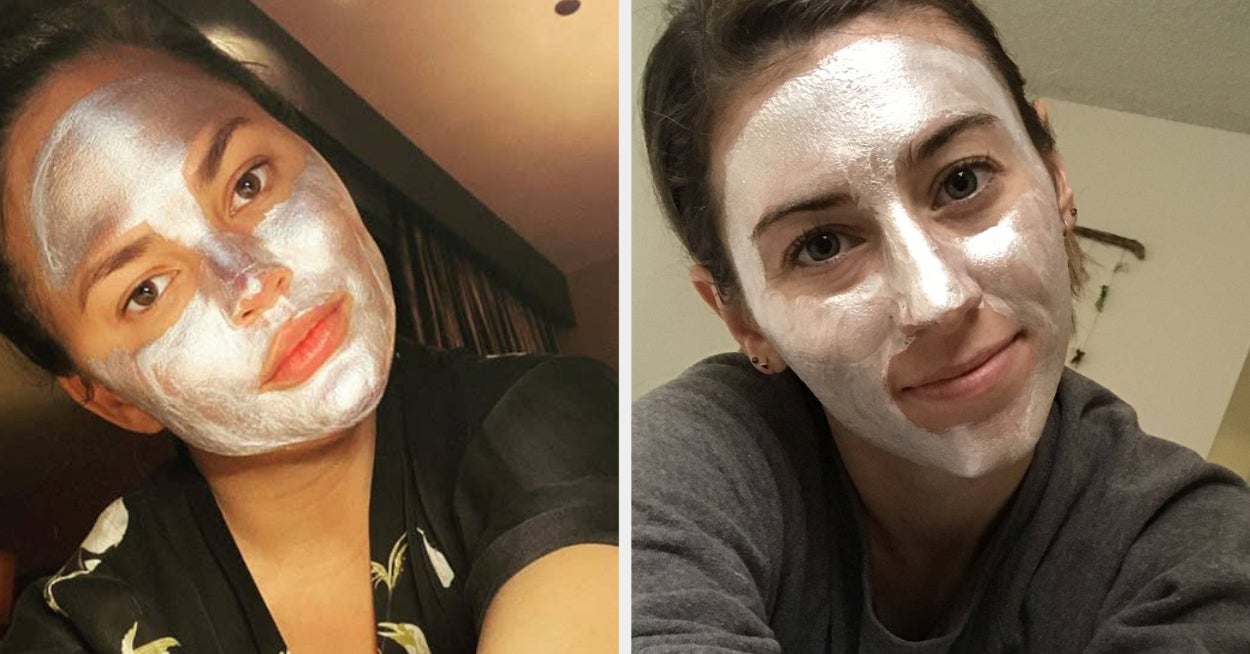
Here's a picture I re-created with Glam Glow's Gravity Mud Mask. Just two ladies relaxin'.
Here's what my skin looked like before I started with Chrissy's routine. I didn't have any breakouts (more on that in a min) and my skin was oily. I also had some hyperpigmentation marks on my cheeks.
Here's what my skin looked like after I used the Foreo Luna 3 device for the first time. The bristles had a silicone texture, so it took me a while to get used to it. I felt like it gave me a deep clean, though. You can also use the settings in the app to massage your skin in different ways, and it walks you through what you should be doing. Did I think the pulse vibrations would win the war against anti-aging? No, but I was down to give it a shot.
I was off to a rough start during the first week. I'm not sure my breakouts were caused by the new products, being on my period, or both. But it definitely was not ideal! I also wasn't brave enough to do a hydration face mask on the plane out of fear of bothering my plane neighbors, so I waited until I was home to let that moisture in.
Things were clearing up during Week 2, and I was honestly VERY impressed with how things were going! I thought my skin was looking brighter and less tired.
I was certain I would hate using the Luna 3 device, but it actually grew on me. It felt like it was really clearing out all the dirt and oils in my pores, and my skin was looking a lot more balanced. The Glam Glow Gravity Mud Mask is one that you peel off. I'm not a *super* big fan of peeling masks, to be honest. It was nice to have a little moment of self-care every week, though!
*A PRP (Platelet Rich Plasma) facial involves extracting platelets from your blood, which is drawn while your face is numbing with the numbing cream. It is then injected back into the skin through the microneedling process, as pictured above. This apparently slows the aging process, giving you a youthful and radiant appearance by helping to stimulate collagen so that the skin can repair and rejuvenate itself. This has also been called the Vampire Facial.
By the time I left, I looked like I had the worst sunburn. I went straight home, where I was told to apply the remaining platelets (as seen in that syringe) on my face for four hours before washing it off with a gentle face wash. My post-care instructions said to keep the area hydrated with hyaluronic acid and rose water for the next 48 hours.
Farrah Penn / BuzzFeed
By the way, the PRP microneedling facials are $150 at The Skin Agency. I chose this place in particular because it's where I go to get laser hair removal, and I love it! It's clean, chic, and everyone's really nice. And I did not get paid to say that.
Here's what I looked like with the platelets on my face versus when I washed it off four hours later:
OK, here's where things began to go downhill — 24 hours later, my redness was almost gone, but I began getting annoying whiteheads on my chin!!! I figured this was part of the purging process, but still! The photo on the right is 48 hours after the facial, where I continued to break out on my chin.
And here's a super close-up of my chin 24 hours and 48 hours after. YIKES!!!!!
It took a full week for my skin to somewhat clear up from THE PURGE. I made sure to drink tons of water to help the rejuvenation process and to help my breakouts go away. I think the facial provided subtle changes. My under-eyes don't look as deep or dark, and my forehead looks a lot smoother.
After copying Chrissy's skincare routine for the fourth week, I noticed a tiny bit of a difference. Here are the before and after photos from the front. The lighting is a tad bit different, but I did my best.
You can see a bigger difference in these next pictures. I know it's impossible to actually shrink your pores, but they do appear to look smaller. My skin feels more polished, and some of the hyperpigmentation is faded.
So, what did I learn from this? While I didn't expect Chrissy to use drugstore products, it's still a hefty bill for skincare. At the same time, I get it! Taking care of your skin is a worthwhile investment. My favorite products ended up being Tatcha's Rice Polish, iS Clinical Cleansing Complex, and, surprisingly, the Foreo Luna 3. But even with all of this, Chrissy still breaks out because she's human! While this was a fun experiment, at the end of the day, try new things if you want. But ultimately, do what's best for your skin!
1.Q: "What does it actually feel like to have milk come out of your body through your nipple?" —laurae486e9cb98
A: When the milk comes out it doesn't really feel like anything. In other words, you feel the squeezing or sucking on your nipple, but it doesn't feel like anything where the milk comes out. One thing that I naively didn't realize was that the milk doesn't just come out of one designated hole on each boob. It comes out kind of like a drizzling shower head. Molly said when a boob expresses milk, it looks like it's weeping – so there's a good visual for you.
Molly adds, "Inside the breast tissue there are these clusters of cells that produce breast milk and they're connected by all of these little ducts that then move toward the nipple. Most women have multiple openings of these ducts at the nipple and they're not always at the very end of the nipple. Some moms spray milk out in different directions and even spray out on the sides of their nipples."
2.Q: "Have you ever breastfed your husband? Or has he ever sucked on your boobs to see what breast milk tastes like?" —helloooofrom182838
A: No and no. True story: My girl friends and I actually tried my breast milk after having one too many glasses of wine one night. We all agreed that it tasted like the Fruity Pebbles milk! It was very sweet. We tried to get my husband to taste it, but he said thinking about it made him gag. 😂 Moral of the story: Get you some friends who will try your breast milk with you! 😉
3.Q: "How much did your boobs grow when your milk came in? Do they deflate after?" —laurae486e9cb98
A: Over the course of my pregnancy, my boobs gradually got bigger. By the last month of pregnancy, I was a full size up. When I squeezed my nipples, a yellowish ~discharge~ came out called colostrum. Sorry, folks, but by this point I think we know pregnancy/childbirth is far from glamorous, and discharge is the most accurate word to describe it! Molly said colostrum is the first milk your body makes for your baby. It is extremely high in calories and antibodies.
After I had my son, my boobs were like giant melons! I had cleavage nearly up to my collar bones. However, when I stopped breastfeeding, they shrank a lot. My boobs went through a roller coaster ride. Before pregnancy, they were tiny, during pregnancy they got a little busty boost, after childbirth they were full-on MILK JUGS (pun intended), and then after breastfeeding they deflated like popped balloons. It is common after breastfeeding for the connective and fatty tissues in your breast to change – and mine did.
And that's why I'll never look at balloons the same again...
Ekaterina79 / Getty Images
4.Q: "Does it hurt or feel weird, like someone is biting you?" –Anonymous
A: I don't want to scare anyone, but I eventually developed severe nipple trauma from breastfeeding. My nipples became scabbed and were constantly bleeding. It got so bad that it hurt to wear clothes and when I pumped my milk would look like strawberry milk in the bottle because so much blood was pumping out with my milk. It was one of the most painful experiences of my life. So, long story short, I eventually had to quit. (Thankfully, my nips made a full recovery and never got infected.)
To figure out what happened to me and why, I explained my experience to Molly. She said, "In general, breastfeeding shouldn't hurt. However, there are some issues that can arise that can cause pain. If you're getting nipple damage or having nipple trauma, that is generally caused by a baby not having a good latch. There is also a small percentage of babies that may have a lip tie or tongue tie. Also, after babies are born, they don't know how to breastfeed. They have the instinct to do it, but they still have to learn how to do it properly. So, without early intervention, a bad latch can cause the nipple to get misshapen inside the mouth and cause it to rub against the roof of the baby's mouth or things like that. That's what causes soreness and trauma to the nipples. Working with a lactation consultation can help prevent those issues. Learn as much as you can and take advantage of the resources that are available to you."
(If you're wondering, I had a lactation specialist in the hospital help me once and then never had anyone look at my son's latch after that. I think, in my case, my son never properly latched and it eventually caused my nipple problems.)
5.Q: "I’ve heard that breastfeeding gives an almost 'euphoric' feeling? Is this common/true?" —rylanmichele
A: Breastfeeding definitely gives off a very nice feeling. I'm not sure if euphoric is the word, and I don't know if I have a word to describe it. It felt like a deep, deep bond unlike anything I've ever experienced before.
According to Molly, breastfeeding releases oxytocin – known as the love hormone – to the mom and the baby. "When the baby releases oxytocin, it has a calming effect and releases all the good hormones in their body. There's also dopamine that gets rolled into that feeling."
A: Pumping kind of feels like there's a vacuum stuck to your nipples. It's an intense in and out "sucking." It doesn't hurt, but it's definitely squeezing your nipple tight into the little tube to suck out as much milk as possible. You are milking yourself and it's a weird experience, but neat at the same time because your body can literally produce food for your baby.
Enjoy this realistic example of a mannequin pumping:
Supersmario / Getty Images
7.Q: "Does breastfeeding change how you feel about your partner sucking your nipples during sex? I worry that breastfeeding would change that aspect of foreplay." —asunseri24
A: Not at all! When your baby is sucking on your boob it is a different kind of intimacy. When I am sexual with my husband, then I am in a different frame of mind and I don't think about my boobs being milk machines, lol. When I was currently breastfeeding, though, we really didn't do much ~boob~ stuff because I would leak milk if it was squeezed and it would just be...a mess. That being said, after having a baby with my husband – and him seeing nearly every ~gross~ thing you can imagine – you're closer in a different way. And, while it may be different, it doesn't forever ruin your sex life!
8.Q: "Can you feel your boobs fill back up with milk after the baby sucks it all out during a feeding or pumping session? If so, what does it feel like and does it hurt?" – Anonymous
A: If it's been a while since you last pumped or breastfed your baby, your breasts will start to get engorged and hard. Also, when they are that full of milk, they hurt and you need to pump or feed or somehow express the milk out. That's why women have to constantly pump or feed every few hours. I remember one time, when my son was staying with my mom and I had saved milk stored in the freezer for him, I decided to go an entire day without pumping. My boobs started leaking and hurt sooooo bad because the milk needed to be released. So, basically breastfeeding is a full-time job. THERE ARE NO DAYS OFF!!!
"Leaking can happen at any time because your body has a reflex that will release breast milk on its own due to hormones. If a mom sees a baby or thinks about their baby, it can trigger the hormones in your body that cause your boobs to start leaking milk. Leaking also happens when you have full breasts that need to be relieved," Molly explained.
9.Q: "What is it like to quit breastfeeding? How do you know when it's time to stop and does it hurt?" – Anonymous
A: Oh gosh, I did a bad, bad thing. I quit cold turkey. It was awful. My boobs literally felt like they were going to explode and they were hard as rocks. I did it because of the ongoing nipple trauma I was having and I just wanted it to all be over. Molly said when you quit abruptly, your body doesn't know that you've decided to stop breastfeeding, so it is still going to produce milk. "We recommend doing a step down method gradually, otherwise you can get very engorged and it's painful. It can also lead to blocked ducts or infections."
On the topic of knowing when it's time to stop, Molly said that while extended breastfeeding is not a cultural norm in the U.S., it is a very common practice across the world. "Feeding babies until they are three, four, or even five years old is popular in areas outside the U.S. If you're going to breastfeed, I recommend doing it for the first six months of life exclusively, then up to 12 months with solid, complimentary foods. After that you can continue for however long is mutually desired between the child and the mother."
I don't know if these are grapefruits or what, but they look hard and that is what engorged boobs feel like.
Peter Dazeley / Getty Images
10.Q: "Did you ever breastfed in public and, if so, did you experience any criticism?" —sarahs4437336cf
A: Because I was working and going to school so much, I ended up pumping more than directly breastfeeding. I took my pump everywhere with me and I remember locking myself in the bathroom stall and pumping in-between classes when I could. When I was at home and people came over, it was a very isolating experience. Like, I was expected to go in a room alone and feed the baby. I was very young, so I didn't really know my feelings toward breastfeeding in public. I kind of just thought it was something that was frowned upon, so I didn't do it. If I were to get pregnant now, I would totally do it – no problem.
Molly adds, "Even though breastfeeding in public is protected by law, not every woman feels comfortable doing it. There isn't a way that we have decided to deal with it as a society, which makes it hard and lonely for some women."
11.Q: "Why do some women produce more milk than others? How do I know that my baby has had enough to eat or if I'm producing enough milk?" —lucym81891
A: I produced a sufficient amount of breast milk at first. But, over time, my milk supply diminished and my son's pediatrician said I needed to supplement formula in with my breast milk to make sure my son was eating enough. This was around the same time my nipples started getting really, really bad. I dreaded every feeding or pumping session. I also had a jam-packed schedule, so I think all those factors together made my body stressed and resulted in not enough milk being produced. But, I'm not an expert, so here's what Molly had to say...
"For the vast majority of women, their bodies are physically capable of producing enough breast milk to support their baby. However, we live in a world where there are multiple aspects that go into this. Breastfeeding is related to hormones, so if you are a mom who has a baby and also has to tend to three other kids or or you have multiple other stressors in your life, it's possible that those stress hormones will suppress your breast milk production. If you go back to work a few weeks or months after you have a baby, that's not how our bodes were physiologically intended to work when it comes to sustaining milk supply for your baby. So, if you're pumping – although pumping is great and allows mom more freedom – it's not going to be as effective as having the baby on the breast. In turn, this tends to take a toll on the breast milk supply. There are multiple things going on at any given point in our lives that may cause issues along the way."
Molly also said that it's crucial for moms to establish their milk supply within the first two weeks of breastfeeding. "During those first few days, your baby is teaching your body how much milk they need to eat."
12.Q: "Why does my baby's poop smell 'good' with breast milk, but smell like death with formula?" —sparksnicole5
A: Breast milk baby poo is definitely different than formula milk baby poo. When I breastfed my son it was more liquid-y and lighter in color. When he was formula fed, it was darker and more solid. As far as odor? IDK, maybe the breast milk poop wasn't as ~strong~. Molly said, "Breast milk is very easy for a baby's digestive system to break down. Formula is not quite as bioavailable to baby, so their system has to work harder to break it down. That may be why there is a difference in smell."
Breast milk poop looks kind of like this:
Andriano_cz / Getty Images
13.Q: "How did you balance breastfeeding and pumping after going back to work full time?" —zepponotzeplin
A: It was very stressful for me. Breastfeeding is a huge commitment and it is constant. If you're not with your baby, you have to pump so your milk continues to come in and so your boobs don't become engorged. If you're with your baby, they are on your boob every two to three hours at first. I think the main thing that helped me focus was just thinking of it as part of my daily routine. It was something that had to be scheduled in. I tried to find things to read or catch up on things I needed to do during pumping sessions.
14.Q: "I always hear breastfeeding isn’t as easy at it seems. What’s so hard about it?" —lizz419bb1ea5
A: I think it's not "easy" because it's a constant job. You have to be with your baby 24/7 to feed them or, if you work, you have to pump every few hours. In addition, it takes a lot of education to breastfeed properly and know the technique. Like now I realize my son probably never latched correctly and I didn't know it. It's hard because while it is ~natural,~ there's a learning curve and a lot of dedication that goes into it.
From Molly's perspective, she said that it can be hard because a lot of women don't have the support of understanding of it that we should have. "It's not expected that a woman is going to have to take off work or have time to pump or get lactation services. Lactation services aren't even covered by most insurances. The lack of systematic support is what makes it so difficult – and the fact that women feel like they have to do it alone. In the U.S. we don't have extended maternity leave, and women have to go back to work very quickly after giving birth. So, things like that makes breastfeeding more difficult."
15.Q: "Does the baby try to get to other peoples' boobs? Like, if the dad isn't wearing a shirt, would the baby try to bite his nipple?" —youcanhavethekidsbutigetthedog
A: When my son was hungry, he would have hunger cues, like turning his head with his mouth open like he's searching for a nipple. However, it wasn't like he was just out to get any boob. I'm sure if you put a boob or nipple right in front of a baby's mouth, they would suck out of instinct. But, I don't think they are constantly searching for it on their own without it being put directly in front of their face. In other words, he never tried to suck my husband's nipples!
These babies sure don't seem interested in dad's nipples.
Studio-annika / Getty Images
And here are a few other answers to questions from the expert...
– Q: "Can you breastfeed with pierced nipples? Can women with implants breastfeed?" —zandraariels
A: Molly said yes to both! "If your nipples are pierced, you want to make sure you remove your jewelry because you don't want it to come off when the baby is nursing. As for implants, most that are done today are placed below the pectoral muscle. So, thats good for breastfeeding because it's not messing with any anatomy inside the breast tissue that's responsible for transporting milk to the nipple."
Q: "How do I tell if my baby is eating enough and how much is too much?" – Anonymous
A: Molly said, "You're supposed to feed the baby on their hunger cues and that is things like opening and closing their mouths, bringing their hands to their mouths, sticking out their tongue, and rooting – where they bob their head as if they are looking for a breast. Moms should feed when they see those cues, and it could be every hour to every couple hours for newborns. If you're exclusively pumping, we recommend pumping every two hours all through the day, around the clock. After that, it will be based on baby's cues, but you should always consult your pediatrician about it. It's also about counting diapers! Your baby should have 6-8 wet and 3-4 poopy diapers per day after they hit 3-4 days old. You'll want to avoid pumping for 3-4 weeks (if possible!) to help the baby establish a good latch and teach your body how much milk the baby needs."
Q: "How did you handle nursing when your baby started teething?! When they bite, do you pull them off the breast or continue through the pain?" —alih4ddff6404
A: The pain associated with teething is when a baby decides to bite. "Teeth can change a baby's latch, but the pain that comes from teeth is when a child bites. It sounds scary, but you can make it through and there are steps you can take to prevent it," said Molly.
If you have more questions about breastfeeding, Molly is available to answer any questions you may have on Lansinoh's website free of charge.
Seventyfour / Getty Images
Do you have any other questions about motherhood? Let us know what you're curious about below and you may be in an upcoming BuzzFeed post!